

My research focus has been shaped to a large extent by the 20 years I spent living and working in Alaska. Climate change is happening twice as fast in the Arctic as in other regions of the world. Permafrost thaw, coastal erosion, changing freeze and thaw cycles, and climate-related extreme events are just some of the challenges with which Arctic communities and sectors are confronted. During my time with various Arctic-focused projects (NASP, EPSCoR, SALIENSEAS, FOCUS) I had come to know many affected communities and organizations who work toward healthy, sustainable futures. I have been thoroughly inspired by our collaborations.
I was born and raised in Budapest, Hungary before my studies and work took me to distant locations. I have a deep passion not only for the Arctic, but all landscapes and the human and ecological communities that depend on them. I see intense beauty from the Pannonian steppe to the Arctic tundra and this appreciation guides my work to explore the sustainability of various social and ecological systems.
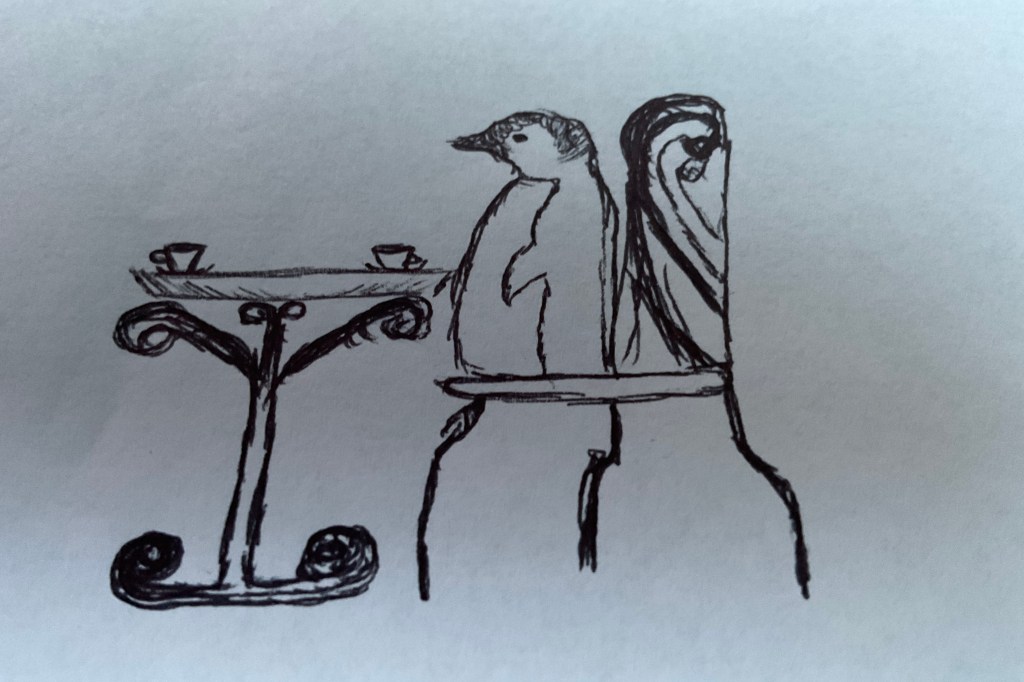
The drawing above of a penguin, dining in splendor, is one of a smorgasbord of doodles my students have produced in a graphic jam exercise over the years. Graphic jam is one activity I employ with undergraduate students to begin thinking about loaded concepts like corporate social responsibility. “Draw responsibility without using any words in 3 minutes.” The prompt results in a rich tapestry of interpretations that intuitively engage different scales and connections in and among social and planetary systems revealing students’ existing, but unarticulated, grasp of issues, scales, connections, and feedbacks. The discussion that follows tends to be lively and engaged.
So why the whimsical doodle above, one might ask, considering penguins and the Arctic are at polar opposites -quite literally- and I work for a business school? This playful portrait of animal welfare is as relevant for sustainability as any materiality matrix. We can think of sustainability as setting and seating this table, allocating what will be on offer and to whom, as we deem necessary and valuable for a shared future. There is an inherent complexity to this pursuit, demanding tools and approaches beyond the reductionist and toward resilience and regenerative design.
EDUCATION
2017 PHD
Natural Resources and Sustainability
College of Natural Science and Mathematics
Department of Natural Resources & Environment
University of Alaska Fairbanks (USA)
2010 MA
Global Environmental Policy
College of Liberal Arts
Arctic and Northern Studies Program
University of Alaska Fairbanks (USA)
2002 BS
Computer Science
College of Liberal Arts and Sciences
Division of Computer Science
Western Oregon University (USA)
 Berill Blair